

Antique Glass and Historic Window Repair in Lancaster, PA
Older windows are an important part of Lancaster County's architectural character. Approximately 41% of the county's housing was built during the 1960s or earlier. In Lancaster City, 77% of the housing dates to the 1960s or earlier, including 54% built before 1940. According to Lancaster Indicators' Age of Housing Stock data, these figures are based on U.S. Census Bureau American Community Survey estimates for 2020–2024.
Many of these properties contain original windows, distinctive glass or openings that don't match today's standard sizes. When a pane breaks or needs to be upgraded for safety, installing ordinary modern glass can noticeably alter the window's appearance.
Lancaster Paint & Glass provides standard, patterned, antique reproduction and custom-cut glass for residential and commercial properties. Whether the project involves an antique window repair in a home or commercial window repair and replacement in an older building, we can help homeowners, contractors and property managers select glass that suits the property's age, design and practical requirements.
Get Help With Window Glass Repair
Guidance for Historic Windows in Lancaster
With so many older homes and commercial buildings throughout Lancaster County, window work often involves more than replacing a broken pane. The glass, sash, proportions and other original details may contribute to a property's architectural character. Lancaster Paint & Glass helps property owners and contractors select glass that addresses the damage or practical need while remaining appropriate for the building.
This preserve-when-practical approach is supported by the National Park Service's Technical Preservation Services division, which develops guidance used by architects, contractors, and historic-preservation professionals. It generally recommends retaining and repairing historic windows when feasible, with replacement reserved for windows that are too deteriorated to repair.
These recommendations aren't legal requirements for every Lancaster County property, but they provide a respected framework for making informed repair-or-replacement decisions.
What Is Antique Window Glass?
The term antique glass may refer to original glass that remains in an older building or newly manufactured reproduction glass designed to recreate its appearance.
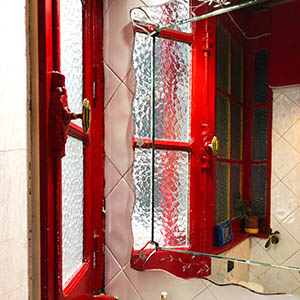
Before modern float glass became standard, manufacturing processes frequently produced panes with waves, draw lines, bubbles and variations in thickness. These irregularities bend and reflect light differently from perfectly flat modern glass. They may be especially noticeable when the window is viewed at an angle or when reflections move across its surface. Maybe you've seen evidence of this while watching old Westerns, where windowpanes often distort the view or create a rippling effect as the cameraman shoots through them.
Lancaster Paint & Glass offers two options for recreating this appearance:
- Antique reproduction glass has a wavy appearance with small imperfections or bubbles characteristic of old window glass.
- Drawn antique glass, sometimes called GNA, has waves and visible lines but doesn't contain the bubbles associated with antique reproduction glass.
These products are newly manufactured. They reproduce the visual qualities of historic glass without requiring an original antique pane to be located and cut.
Lancaster Paint & Glass primarily specializes in clear, obscure, patterned, mirrored and antique reproduction glass. We don't typically focus on detailed artistic or custom-colored stained-glass work.
Matching Antique Glass for Windows and Furniture
Antique reproduction glass isn't limited to historic windows. It can also be custom cut for older cabinets, china cabinets and furniture with glass-pane doors.
After accidentally breaking an original pane in an early-1800s cabinet, one customer brought the door to Lancaster Paint & Glass. Our team replaced the broken piece with wavy glass selected to complement the remaining panes. His door was ready the following day, and he reported that the cost was approximately half of what he had expected.
"...The end result that matches the other panes could not be better."
— Peter M., Google review
Of course, turnaround times and costs vary according to the glass selection, required dimensions, availability, and complexity of the work. (Learn more about our pricing.)
How Can You Identify Original Window Glass?
No single characteristic can prove that a pane is original. Windows are repaired over time, and panes within the same sash may have been installed during different periods. But, several details can indicate that glass may be older:
- Waves or distortion: Straight lines may appear to bend or shift when viewed through the pane.
- Small bubbles: Earlier manufacturing methods sometimes left tiny air pockets in the glass.
- Draw lines: Faint vertical or horizontal lines may reflect the process used to form the pane.
- Uneven thickness: The glass may not have a uniform thickness from one edge to another.
- Irregular reflections: Light may ripple across the surface instead of producing a flat reflection.
- Differences between adjacent panes: A perfectly clear pane surrounded by wavy ones may be a later replacement.
- Period window construction: Historic sash, muntins, glazing points and putty can provide context, although these components may also have been repaired.
The age of a building alone doesn't establish the age of its glass. A glass or preservation professional should evaluate the pane as part of the complete window.
When Should You Preserve an Old Window?
Preservation should be considered when a window contributes to the building's appearance and its principal components remain serviceable or repairable.
Keeping the existing window may be appropriate when:
- The sash, frame, and muntins are structurally sound.
- The window contains original or distinctive glass.
- Its dimensions and profiles contribute to the building's architectural style.
- The damage is limited to one pane or a small number of components.
- The opening has an unusual shape or size.
- A compatible repair can correct the problem without removing significant material.
- The property is historically designated or subject to local preservation requirements.
A broken pane doesn't automatically require a complete replacement window. In many cases, new glass can be custom cut for the existing sash while the rest of the assembly remains in place.
An old window repair project may involve replacing broken glass, renewing failed glazing compound, repairing a balance or crank, replacing storm-window glass, or addressing another isolated problem. Work involving rotted sash, deteriorated frames, or missing wood components may require a contractor who specializes in carpentry or full window restoration.
When Is Window Replacement Appropriate?
Replacement may be justified when a window is structurally unsound, extensively deteriorated, or unable to meet the project's safety and performance requirements through practical repairs.
Examples include:
- Widespread rot, corrosion, or structural damage
- Repeated water intrusion affecting the surrounding construction
- Missing components that can't be reproduced reasonably
- A failed insulated glass unit with condensation between its panes
- Glass that doesn't satisfy applicable safety requirements
- A previous replacement window with little architectural significance
- Performance requirements that the existing assembly can't accommodate
For an architecturally significant property, a replacement should be selected with attention to the original window's size, configuration, profiles, materials, glass appearance, and placement within the opening. These details are particularly important on prominent, street-facing elevations.
Replacing Broken Glass in an Old Window
Cracked glass shouldn't be patched with adhesive and treated as a permanent repair. Even a small crack weakens the pane and can create a safety concern.
Lancaster Paint & Glass can evaluate the existing window, help identify an appropriate replacement and custom cut the selected glass to fit the opening. The process generally involves:
- Examining the surrounding panes and window construction.
- Measuring the opening and determining the required glass thickness.
- Selecting standard, drawn antique, antique reproduction or patterned glass.
- Removing the damaged pane and deteriorated glazing material.
- Cutting the replacement glass to fit the opening.
- Securing and reglazing the new pane within the sash.
Matching historic glass requires more than choosing a product that looks old. The amount of distortion, visibility of draw lines, presence of bubbles, color and location of the window can all influence which option looks most appropriate. With its selection of antique and patterned glass, custom-cutting capabilities and experience dating back to 1884, Lancaster Paint & Glass is well equipped to help customers find a suitable match for an old window.
Improving Efficiency Without Losing Historic Character
A drafty window doesn't necessarily need to be removed. Heat loss can occur through the glass, but it can also result from gaps around the sash, frame or deteriorated glazing compound.
Depending on the condition and construction of the window, potential improvements may include:
- Renewing loose or deteriorated glazing compound
- Caulking appropriate stationary joints
- Adding or replacing weatherstripping
- Repairing glass in an existing storm window
- Adding a compatible interior or exterior storm window
- Replacing a failed insulated glass unit
- Using performance glass where the window can accommodate it without an unacceptable change in appearance
Lancaster Paint & Glass offers Low-E glass, solar-reflective glass, insulated glass units, and argon-filled window options. The company's existing window services also include replacing glass in storm windows and broken or fogged insulated units.
Depending on the project, modern glazing may help address thermal performance, solar heat, UV exposure, safety or outside noise. The available solution will depend on the window's construction, the required glass thickness and whether altering the glass would affect its historic appearance.
For a historically significant building, improvements should be chosen carefully. Highly reflective coatings, altered pane configurations, or visibly modern materials can change the character of a window even when they improve its technical performance.
Antique Glass for Historic Commercial Buildings
Historic storefronts, offices, churches, institutional buildings, and adaptive-reuse projects may need replacement glass that respects the original architecture while supporting current safety and durability requirements.
Lancaster Paint & Glass can source and install antique reproduction commercial window glass for applications such as:
- Historic storefront windows
- Interior office doors and partitions
- Transoms and sidelights
- Display cabinets
- Obscure restroom windows
- Decorative panes in hospitality or institutional properties
- Architecturally significant window openings
Commercial glass requirements vary based on the location of the pane and use of the building. Tempered or laminated safety glass may be required in doors, sidelights and other hazardous locations. These requirements should be evaluated before the glass is ordered.
Planning a Historic Window Glass Project
If possible, retain an undamaged pane or a safely packaged fragment of the original glass. Photographs can help, but a physical sample often provides better information about the glass's color, thickness, texture and degree of distortion.
Useful project information includes:
- Photographs of the complete window
- Close-up images of the existing glass
- Approximate pane dimensions
- The number of panes involved
- The property's approximate construction date
- Whether the application is residential or commercial
- Known historic-district requirements
- Privacy, safety or performance concerns
For a larger historic window restoration, Lancaster Paint & Glass can assist with the glass portion of the project while coordinating specifications with the property owner, contractor, architect, or preservation professional.
Whether you need information, samples, a quote or help selecting glass for a historic window repair, our team would be glad to discuss your property and project requirements.
Frequently Asked Questions
How do you replace an old window with a new one?
A complete window replacement begins with measuring the opening and determining whether an insert unit can fit inside the existing frame or the entire frame must be removed. After the old assembly is taken out, the opening is inspected, prepared, insulated and sealed before the new unit is installed.
Full window replacement is different from glass replacement. If the problem is limited to a broken pane, fogged insulated unit, damaged balance, crank or screen, a complete new window may not be necessary.
Can I replace just the window and not the frame of an old window?
An insert replacement window can sometimes be installed within an existing frame if that frame is square, stable and free from serious deterioration. This approach preserves more of the surrounding trim but reduces the visible glass area slightly because the new unit sits inside the old frame.
If "window" refers only to the glass, an individual pane or insulated glass unit can often be replaced without removing the frame.
Can new glass match the other panes in an old window?
Antique reproduction or drawn antique glass can provide a closer visual match than ordinary float glass. An exact match isn't always possible because original panes and reproduction products vary. Comparing samples beside an existing pane in natural light is the best way to evaluate compatibility.
Can antique-style glass be used where safety glass is required?
Certain patterned options can be tempered, as indicated by the "(T)" beside the product name. Other situations may call for laminated safety glass. The correct choice depends on the glass type, pane dimensions and installation location.
Is antique reproduction glass actually old?
No. It's newly manufactured glass designed to reproduce waves, bubbles, lines or other visual characteristics associated with older production methods.
Should I bring a piece of the existing glass to the shop?
An intact pane or safely protected fragment may help with matching, but broken glass should only be handled and transported with appropriate precautions. Photographs taken in natural light from several angles are also valuable.
Could the paint surrounding an old window contain lead?
Windows in buildings constructed before 1978 may have lead-based paint beneath newer finishes. Removing glazing, scraping paint or disturbing the sash can release contaminated dust. Appropriate lead-safe procedures should be followed whenever old painted surfaces are affected.
Does work on a historic window require approval?
It may. Requirements depend on the property's designation, location and applicable local rules. Owners of regulated properties in Lancaster and nearby counties should consult the appropriate historic commission or preservation office before altering prominent windows or replacing historically significant glass.
- Select a Category:
 Serving Lancaster County and surrounding areas from our location at 751 E. Ross St. Lancaster, PA 17602